
Free plastic recycling
lesson plans for schools
Ready-to-teach units, written for UK schools, that turn your school’s plastic waste into real products made by students on Sustainable Design Studio desktop recycling machines. Every unit maps to the England D&T national curriculum, or to GCSE and A level content, so it slots into what you already teach.
This is a preview. Try it with a class and tell us what to fix. We update the curriculum from teacher feedback.
Classroom units
Ages 5 to 18
14
Flagship lessons
One product per student
8
Classroom kits
From one classroom desk to a full D&T workshop
4
Choose the kit that fits your school
The recommended setup is the Desktop Shredder V2 with the Injection Mini V2, which takes a class from waste plastic to a finished product. Three smaller kits suit schools with a lower budget or no workshop. Every unit says which kit it needs.
| Kit | Machines | What students make | Space and power | Price from (GBP) |
|---|---|---|---|---|
| C. Core workshop (recommended) | Desktop Shredder V2 + Injection Mini V2 + Premium Moulds | The full mould range: sunglasses, chargers, torches, games, and homeware | 85kg shredder (220 to 240V), 25kg injector on a bench, and a workshop air compressor | £2,745 + £925, moulds from £230 |
| A. Bottle to filament | Filament Maker V2 + a school 3D printer | 1.75mm filament from PET bottles, then 3D printed designs | 2kg, 48W, any classroom desk | £190 kit, £290 assembled |
| B. Portable | Shredder Mini V2 + Extruder Mini V2 | Carabiners, pens, spinning tops, and bottle openers | 10kg extruder and mains power for the 300W heater; moves between rooms | £200 + £1,000 |
| D. Design your own | Kit C + 3D Printed Insert Holder (PM013) + a school 3D printer | Products from mold inserts students design and print themselves | As Kit C | Holder from £240, free starter file |
Add a Fume Extractor V2 for any heated machine. Plastics: the injection machines take HDPE, PP, PLA, PETG, ABS, PS, TPU, and LDPE, but not PET. PET bottles go to the Filament Maker V2 instead. Prices are from each product page. There are no bundle prices or discounts, because the website prices are our lowest. Schools can order on a purchase order.
Units for every age, from primary to A level
Pick the units that fit your scheme of work. Primary schools start with P1 and P2. A secondary school with Kit C should run S1 first with ages 11 to 13: it teaches the full process and every student leaves with a finished product. S2, S3, and S4 build on it. GCSE and A level units cover the polymer, manufacturing, and sustainability content common to the AQA, OCR, Pearson, and Eduqas specifications; check your own board’s specification numbers.
| Unit | Ages (school stage) | Lessons | Kit | Main subject |
|---|---|---|---|---|
| P1. Plastic detectives | Ages 5 to 7 (KS1) | 4 | None | Science: everyday materials |
| P2. Our class product | Ages 7 to 11 (KS2) | 6 | C | D&T design and evaluate |
| S1. Waste to product (flagship) | Ages 11 to 13 (KS3) | 8 | C | D&T making and materials |
| S2. Bottle to filament | Ages 12 to 14 (KS3) | 6 | A | D&T CAD/CAM |
| S3. Design your own mould | Ages 13 to 14 (KS3) | 10 | D | D&T design and CAD/CAM |
| S4. Powered product, charger or torch | Ages 13 to 14 (KS3) | 8 | C | D&T electronic systems |
| S5. Portable production | Ages 11 to 14 (KS3) | 4 | B | D&T making |
| G1. Polymers and the circular economy | Ages 14 to 15 (GCSE) | 5 | Any, as a demonstration | D&T core technical principles |
| G2. Batch production and quality control | Ages 14 to 15 (GCSE) | 6 | C | D&T scales of production |
| G3. Prototyping for coursework | Ages 14 to 16 (GCSE) | 4 sessions | C or D | D&T coursework (NEA) |
| A1. Testing recycled polymers | Ages 16 to 17 (A level) | 6 | C | Product design: materials |
| A2. Designing for recycled manufacture | Ages 16 to 18 (A level) | 5 | D | Product design coursework (NEA) |
| C1. Eco club, the school plastic loop | Ages 7 to 18 (club) | 6 sessions | C | Enrichment, geography, and PSHE |
| C2. Enterprise, make and sell | Ages 11 to 18 (club) | 8 | C | Enrichment, business, and marketing |
Every unit has editable PowerPoint slides with teacher notes, a Word teacher guide, and Word worksheets, all in the free download pack. Timings assume 50 to 60 minute lessons and a class of up to 30 working in small groups on one machine setup.
Eight lessons from plastic waste to a product every student keeps
For ages 11 to 13 (KS3) with Kit C. The big question: can we turn the plastic our school throws away into a product someone wants? With the Spinning Top (PM015), Carabiner Clip (PM014), or Toy Brick (PM029) mold, a class set comes off the machine in one lesson. Lessons 3, 6, and 7 rotate groups of four to six through four stations (machine, sort and prep, quality control, and design), so 30 students stay busy around one machine setup.
Lessons 1 to 4: understand the material
-
Lesson 1. The plastic problem
-
Lesson 2. Identify and prepare
-
Lesson 3. Safe shredding
-
Lesson 4. Product analysis and brief
Lessons 5 to 8: design, make, and evaluate
-
Lesson 5. Design development
-
Lesson 6. Production run 1
-
Lesson 7. Quality control
-
Lesson 8. Evaluate and present
Safety for teachers and technicians
Add every machine to your department’s risk assessment before students use it, and never let students run a heated or powered machine unsupervised. BS 4163:2021 is the UK code of practice for health and safety in D&T in schools. Sustainable Design Studio machines are UKCA and CE certified, and the Desktop Shredder V2 and Injection Mini V2 are fully enclosed with interlocks. Run fume extraction, such as a Fume Extractor V2, whenever a heated machine is hot. PVC (code 3) is never heated.
| Age | Students may | Staff only |
|---|---|---|
| Ages 5 to 7 (KS1) | Collect, wash, sort, and count plastic; watch demonstrations from behind a marked line | All machine operation |
| Ages 7 to 11 (KS2) | As above, plus press the Injection Mini V2 inject button with an adult beside them and the door closed. Ages 9 to 11 may feed pre-sorted pieces into the Shredder Mini V2 with the table mount fitted, one-to-one with an adult | All other machine operation, including heating and loading the Injection Mini V2, opening hot molds, and running the Desktop Shredder V2 |
| Ages 11 to 14 (KS3) | Operate the Desktop Shredder V2 and press the Injection Mini V2 inject button under direct supervision, after a demonstration and a signed safety check-off; crank the Extruder Mini V2 under direct supervision | Opening hot molds, changing molds, clearing jams, and loading and heating machines |
| Ages 14 to 18 (GCSE and A level) | Operate all machines with the teacher in the room, after a recorded competency sign-off | Maintenance, compressor settings, and jams |
PPE: safety glasses, long sleeves in natural fibres, hair tied back, and heat-resistant gloves for whoever handles molds. A respirator is recommended, not required, when the machines run with fume extraction in a well-ventilated room; see our PPE guide. Without extraction, do not run heated machines in class. The Desktop Shredder V2 takes collected rigid plastic up to 3mm thick, and rejected parts from Sustainable Design Studio moulds can go straight back in. CLEAPSS members can use GL495, CLEAPSS’s guide to a fume control unit for the Sustainable Design Studio injection moulding machine. The Injection Mini V2 has been provided to CLEAPSS.
Real people making real products from recycled plastic
Use these as lesson starters. Each one shows students that recycled plastic products are made and sold by real people, often starting small. Müll Club also pitched on the BBC’s Dragons’ Den: watch the pitch.
 School
Meridian High School, USA
An IB school built a mobile recycling cart. Students shred lunch containers and mould plant pots, carabiners, and chess sets, and now design their own moulds.
 Business
Müll Club x Lush
Müll Club made combs for Lush from recycled plastic.
 Business
PANGEA sunglasses
A Bali-based company that made sunglasses from mangrove clean-up plastic on a Sustainable Design Studio Arbour Injection Machine V1. Our Sunglasses Mould V2 also runs on the Injection Mini V2.
 Art
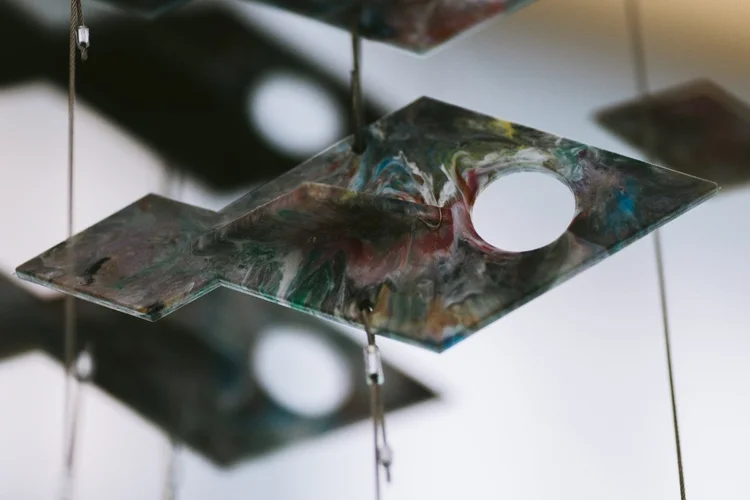
Sum Place, UK
A 250kg installation of 2,500 injection-moulded fish, made from recycled plastic for North Shields Transport Hub.
Download the pack
Get the free teaching pack
Fill in the short form below and we’ll take you straight to the download page. Free to use and adapt in your school.
All 14 units. Every unit has editable PowerPoint slides with teacher notes, a Word teacher guide, and Word worksheets. Each unit also has its own zip if you only need one.
Get the packLesson plans, safety, materials, SEND and EAL adaptations, and an assessment rubric for every unit.
Get the packSorting and weighing record, machine safety check-off, product specification, production log, defect inspection, evaluation, vocabulary cards, and machine safety cards. Included in every unit’s pack.
Get the packWe use your details to send you the pack and to see which schools use it. Updates are optional and only sent if you tick the box. Read our privacy policy.
Prices, purchase orders, and a quote for your school
Every price on this page comes from the product page. There are no bundle prices or discounts, because the website prices are our lowest. We ship worldwide and can send a written quote for your finance team.
The recommended kit
How schools buy
-
Purchase orders accepted
-
A quote for sign-off
-
Talk it through
FAQ
Classroom curriculum, answered
Question not covered here? The team replies within one to two working days. Get in touch
Help us improve it
This is a Teacher Preview Edition. Tell us what worked, what didn’t, and what you would change. We will update the curriculum from teacher feedback.